What are key signs of poor welfare in kennelled dogs?
If one or more of the ‘Five Needs’ is not adequately provided for, dogs may show signs of poor welfare. Observing dogs for specific stress-related behaviours and any changes in their usual behavioural routines and repertoire can be a useful and relatively simple way to assess welfare. Some behavioural changes can also indicate underlying health problems. Practice suggests a minimum of daily observations.
Behavioural observations can take place during kennelling, exercising, training sessions, operations and/or during transport. Identifying key places and times when particular behaviours occur may aid in understanding what is causing them. As human presence/absence can influence the presentation of some welfare indicators, remote monitoring using video cameras can be a useful way to observe dog behaviour in the absence of people. A range of behaviours that indicate poor welfare (based on scientific research) are summarised in Table 1.
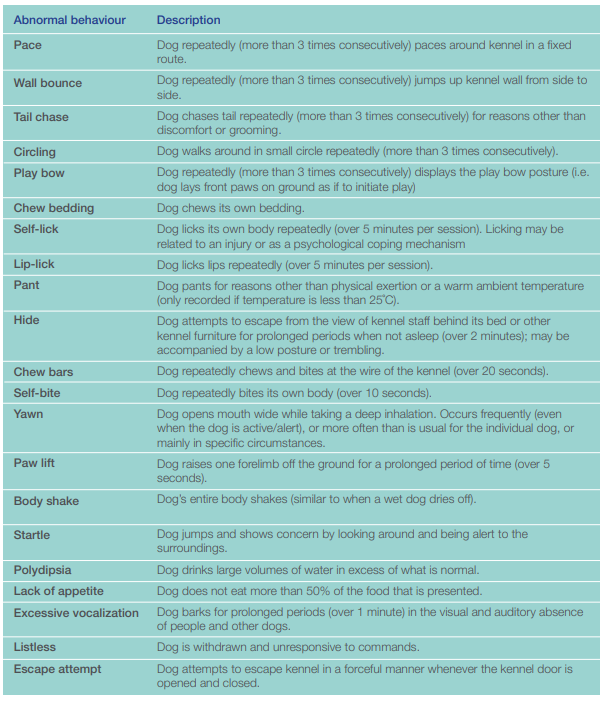
Figure 1 illustrates some examples of behaviours indicative of poor welfare (stress/anxiety) that have been observed in kennelled working dogs and which may be related to inappropriate kennelling. These behaviours can occur in both the presence and absence of people.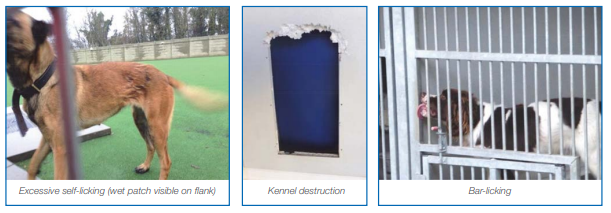
The behaviours shown in Figure 2, often referred to as ‘stereotypies’, are highly repetitive and appear to serve no obvious purpose (though they may be a way in which the dog attempts to cope with an unsuitable kennel environment). They typically occur in the presence of people but can also occur when people are absent.
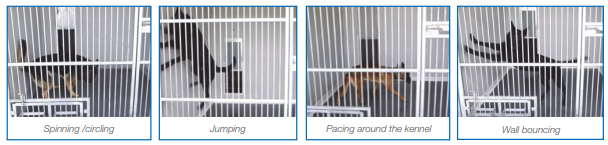
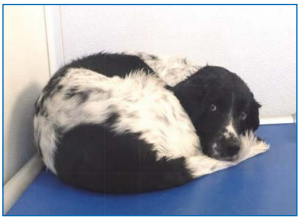
Whilst these behaviours are typically regarded as signs of frustration due to an inadequate environment, scientific research has highlighted that there may be a distinction between dogs showing repetitive behaviours only when people are present (or at times of high arousal, e.g. when other dogs in an exercise area/training session are in view of kennelled dogs), and dogs performing repetitive behaviour when people are absent. Dogs that exhibit repetitive behaviour in the absence of high arousal events may be experiencing chronic stress. This emphasises the value of observing dog behaviour using video cameras, to identify how dogs behave in the absence of high arousal events including the presence of people. Fearful behaviour can also indicate poor welfare and is sometimes less obvious than the repetitive or destructive behaviours described above. Fearful behaviours can include withdrawal (Figure 3), hiding, trembling and low body posture. Fearful behaviours can occur both in the presence and absence of people.